Insights
Workforce Development
From Pharmacy Counter to Healthcare Data: Rawan Alsaid Suliman's Path Into Health Informatics
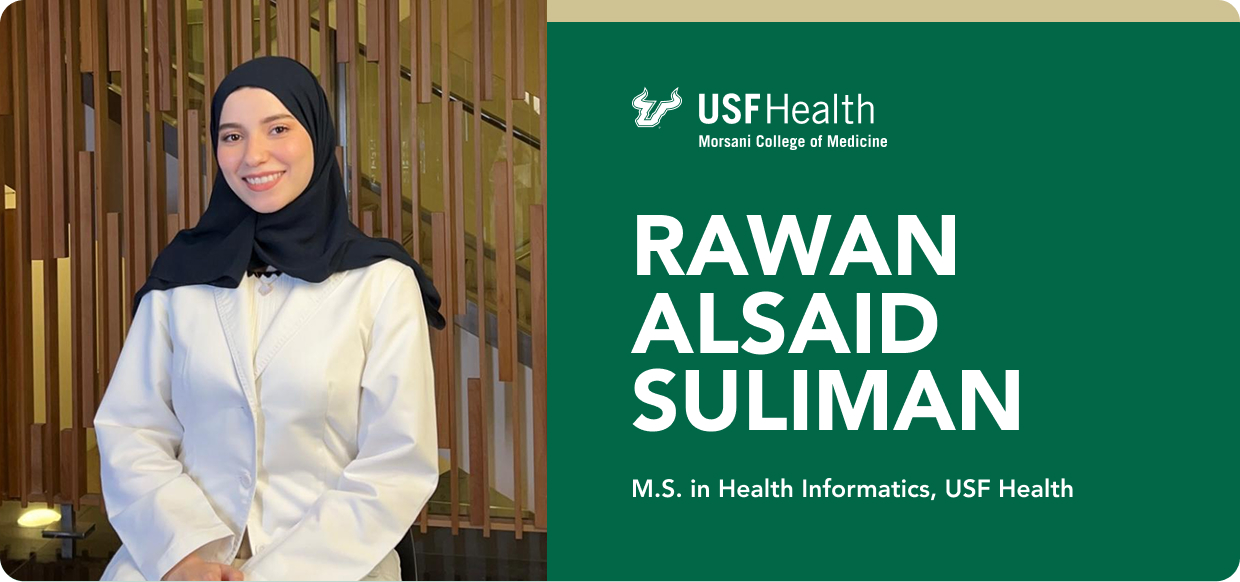
Rawan Alsaid Suliman spent years behind a pharmacy counter in Saudi Arabia before she ever touched a line of SQL. As a pharmacist at Al Hokail Medical Group, her work was clinical, hands-on, and immediate. But somewhere in that work, she started wondering: what happens to all the information behind the medication, the patient record, the system that made each decision possible?
That question eventually led her to USF Health's Master of Science in Health Informatics, completed through the Morsani College of Medicine in August 2026. "After working as a pharmacist, I realized I wanted to expand my career beyond traditional clinical pharmacy and become more involved in the technology and data side of healthcare," she said. Health informatics offered a way to do both at once, combining a clinical foundation she'd already built with a growing interest in analytics and healthcare technology. USF Health's reputation made the decision easier, and since she was already living in the Tampa Bay area, joining the USF community felt less like starting over and more like a natural next step.
The part of the program that stuck with her most wasn't a lecture or a textbook case study. It was hands-on work with healthcare and medication datasets, using tools like SQL, to take raw data and turn it into something usable. "I enjoyed taking raw data, cleaning and analyzing it, identifying patterns, and then turning those findings into something meaningful through dashboards and reports," she said. That experience reinforced her interest in healthcare analytics and helped clarify the direction she wanted to take her career.
That experience helped shape the direction she wanted her career to take. She'd started the program as a pharmacist looking to expand her skill set. She finished it pursuing roles in health informatics, healthcare analytics, and clinical data, roles she hadn't been considering when she enrolled. What made the transition feel natural was realizing her clinical background and her new technical skills weren't in competition with each other. "It helped me understand that my pharmacy experience does not have to be separate from informatics, the two can complement each other," she said.
Rawan balanced her studies while navigating several personal and professional transitions. She was adjusting to a new country, building a life with her husband in the United States, and working through her own professional transition into the U.S. healthcare system, all at the same time she was completing her degree. The program's online format gave her something she needed more than convenience: control over her own schedule. "Having the flexibility to complete coursework online allowed me to manage my personal responsibilities while still staying committed to my education," she said. It took discipline, but structuring her studies around the rest of her life, rather than the other way around, made the balance possible.
By the end of the program, she'd built a specific, practical skill set: SQL, Excel, Tableau, healthcare data management, data quality, and a much deeper understanding of how information moves through EHR systems, and how data quality issues ripple into clinical and operational decisions down the line. In her own words, much of that came together through hands-on coursework projects involving healthcare data, including work with medication datasets — that's where the tools really clicked, even if the specific applications weren't always spelled out in the formal curriculum. She also earned her CAHIMS certification along the way, adding another credential to back up what she'd learned. As she now works toward her first formal role in health informatics or healthcare analytics, she says those skills have already changed how confidently she approaches healthcare data and how she talks about her own qualifications in interviews.
Her advice to someone considering the same path echoes her own experience exactly. "You do not necessarily have to come from a technical background," she said. "I came from pharmacy, and the program helped me develop skills in areas such as analytics, databases, information systems, project management, and healthcare technology. It can open your mind to career paths within healthcare that you may not have considered before."
She credits the support available through student success representatives with helping her manage the demands of the program alongside her personal and professional responsibilities. Having resources available throughout the program and a structure that allowed her to balance coursework with her other responsibilities made a real difference. "The flexibility allowed me to stay connected to USF Health and continue progressing toward my degree even while managing major personal and professional transitions," she said.
Rawan’s experience reflects her individual circumstances and is not intended to represent typical results or guarantee specific career, employment, or professional outcomes for other students.