Insights
Workforce Development
Learning to Build With AI: Michael Diener's Path Through SMU's MACT Program
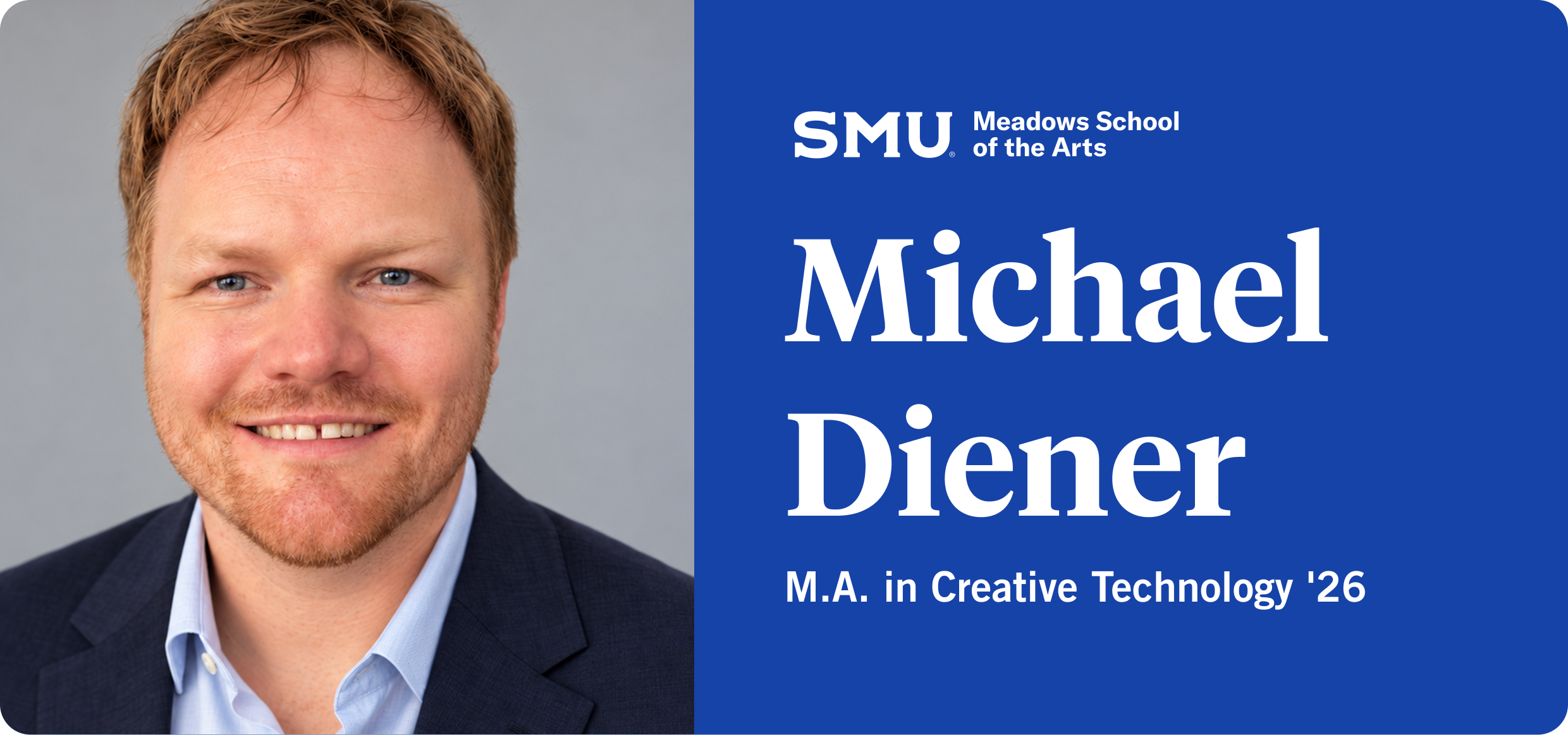
Before enrolling in SMU's Master of Arts in Creative Technology, Michael Diener spent twelve years as a SAG-AFTRA actor and screenwriter in Los Angeles, followed by a year and a half at Innodata, ranking AI model outputs and documenting why they failed, the human feedback work that trains AI systems how to behave.
That work showed him a gap he wanted to close. "The people building AI characters had never had to hold one together under pressure, and the people who had, actors, had no way into the building," he said.
MACT stood out because of what it wasn't. "I chose MACT because it was the only master's program I found that was building with AI instead of studying it from a distance, and it wasn't a computer science degree," he said. "This degree teaches you to decide what the code should do."
The program is organized around three areas: Generative Intelligence and AI, Interactive Architecture, and Creative Code. Diener came in drawn to the first, given his background, but coursework in Interactive Architecture surprised him by how concrete and measurable it turned out to be. Working in XR (extended reality) pushed him to quantify things he'd previously only sensed as a performer, like how long a pause can run in a conversation before a person stops believing anyone is present. His working answer, developed through coursework, landed around 1.9 seconds. "Those are findings from coursework, and they changed how I think about timing in every conversational system I touch."
Diener also pointed to the program's critique process, and specifically working with instructor Ira Greenberg, as some of the most valuable parts of his experience. Greenberg wrote the first book on Processing, the programming language that introduced a generation of artists to code, and has spent close to twenty years building SMU's Center of Creative Computation. "Someone who paints, codes, and ships had built this program," Diener said, "and that told me it wasn't a marketing wrapper on a CS degree."
For anyone considering the program who worries whether they're too technical to be creative, or too creative to be technical, his answer is direct: "The two skills aren't in competition. They're two halves of one test. Can you specify what a character must never do, and can you write the test that proves it didn't? The first half is craft. The second half is engineering. Most people have one and assume the other is the hard one. It isn't. The hard one is whichever you haven't practiced yet, and MACT makes you practice it."
Asked to describe the program in his own words, Diener said: "You learn to build software by deciding what it should do and holding it to that, using AI tools to write the code while you own the judgment. The graduates leave with things they made, not things they studied."
To learn more about the program, watch this short video at https://youtu.be/XQwT_fR3_jc or visit https://www.smu.edu/meadows/areasofstudy/creativetechnology.
Michael Diener's experience reflects his individual creative and professional circumstances and is not necessarily representative of the experience of all MACT students. Individual experiences and outcomes may vary. His experience should not be interpreted as a guarantee of specific academic, creative, professional or career outcomes.
.jpg)